Libraries preserve decades-and often centuries-of research, culture, history, and institutional knowledge. However, aging paper, fragile bindings, fading print, repeated handling, and outdated storage formats can put valuable collections at risk.
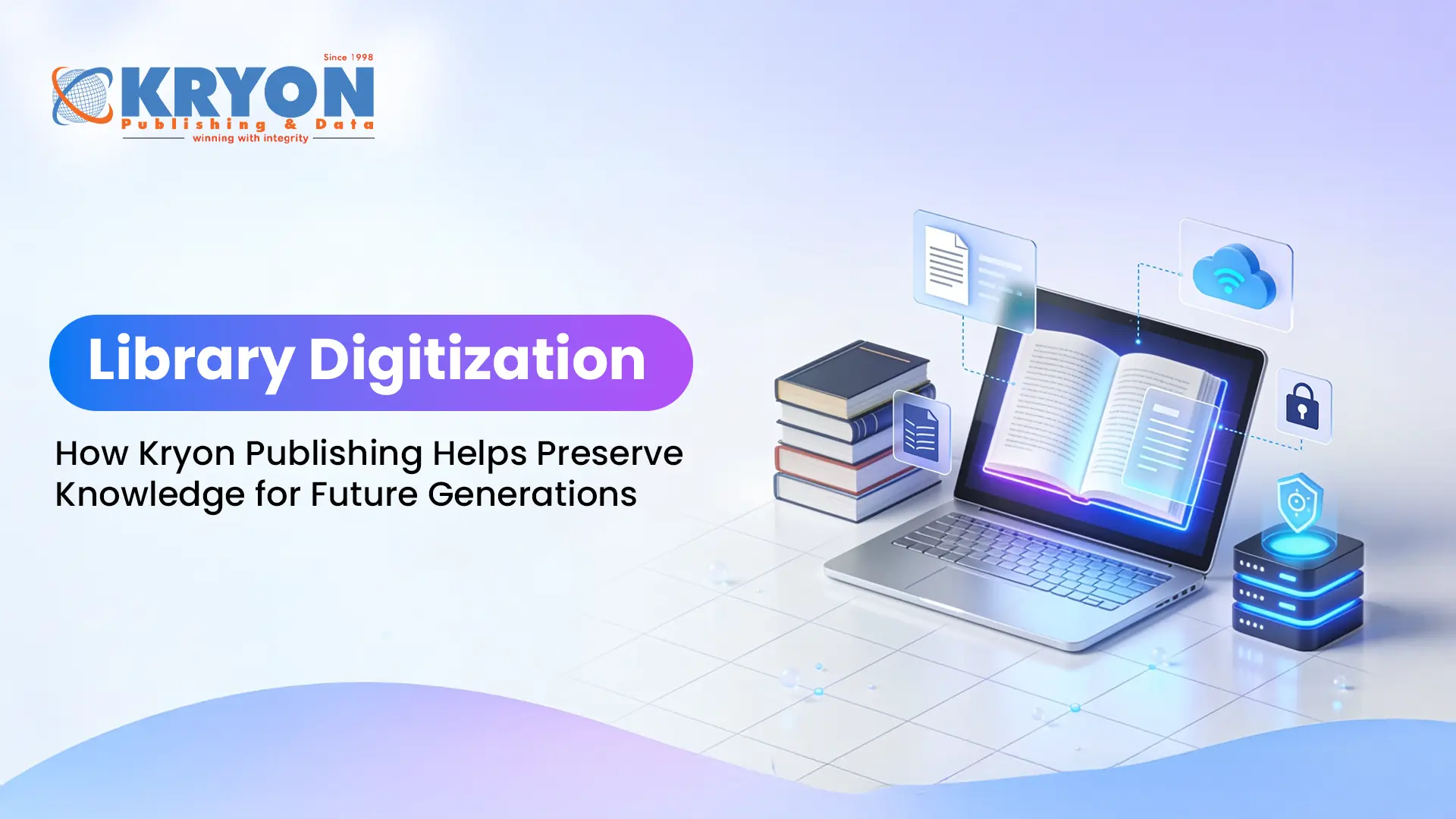
Library digitization provides a practical way to preserve these materials while making information easier to search, access, organize, and manage.
At Kryon Publishing, we support libraries, academic institutions, and research organizations in transforming physical and legacy collections into structured, searchable, and accessible digital resources.
Libraries today face the challenge of protecting physical collections while meeting growing expectations for digital access.
Common challenges include:
Physical deterioration - paper, bindings, and print can degrade over time.
Limited access - physical collections often require users to be present at a specific location.
Storage constraints - growing collections require additional physical space and preservation resources.
Difficult information retrieval - valuable information can remain undiscovered when materials are not searchable or properly indexed.
Risk of loss - deterioration, physical damage, environmental conditions, or unexpected events can threaten irreplaceable materials.
A structured digitization strategy can help address these challenges by creating digital resources that are easier to preserve, discover, manage, and access.
Effective digitization involves more than scanning pages. It requires a structured workflow covering content assessment, conversion, OCR, metadata, quality assurance, preservation, and system integration.
Every collection has different requirements.
Before digitization begins, the materials can be assessed based on their type, volume, condition, structure, preservation priorities, metadata requirements, and intended digital formats.
This helps establish an appropriate workflow before large-scale processing begins.
Books, journals, manuscripts, research documents, historical materials, and archival records can be converted into suitable digital formats while maintaining the integrity of the source content.
Quality validation throughout the process helps identify problems such as missing pages, incorrect sequencing, unreadable content, and conversion inconsistencies.
Scanning preserves the visual appearance of a document, but an image of a page is not necessarily searchable.
Optical Character Recognition (OCR) converts text within scanned pages into machine-readable content. This allows information to be searched, indexed, and retrieved more efficiently.
For large collections, OCR can significantly improve usability by helping researchers, students, and other users locate relevant information without manually reviewing individual pages.
Digitized content becomes more useful when people can find it easily.
Metadata can capture information such as:
Title | Author | Publication Date | Subject | Keywords | Language | Identifiers | Document Type
Kryon Publishing supports metadata structuring, content tagging, and indexing to improve the organization and discoverability of digital collections.
For large-scale projects, AI-assisted processes can also support metadata extraction and content categorization, with appropriate quality validation to help maintain consistency.
Digitization should consider not only immediate access but also how digital resources will be managed over time.
Depending on the institution's requirements, digital preservation practices can include structured file organization, secure storage, backups, access controls, encryption, and version management.
Creating appropriately managed digital versions can also reduce repeated handling of fragile originals.
Digitized materials need to work within the institution's existing information environment.
Kryon Publishing supports the integration of structured digital content with institutional repositories and existing content systems, helping organizations store, manage, retrieve, and provide appropriate access to their digital resources.
Library digitization should not be treated as a one-time scanning project. A useful digital collection needs to remain organized, searchable, accessible, and manageable as technology and user expectations evolve.
Kryon Publishing supports this through capabilities including:
Digital Library Solutions - digitizing and organizing books, research materials, and archival collections.
Metadata and Content Tagging - improving classification and information retrieval.
Structured Content Conversion - transforming legacy materials into organized digital formats.
Multilingual and Accessible Content - preparing resources for diverse audiences and accessibility requirements.
Scalable Workflows - supporting both specialized collections and large institutional digitization projects.
The value of digitization extends beyond convenience. It helps institutions preserve knowledge while making it more useful for research, education, and future discovery.
A well-managed digital collection can provide:
Expanded Access - Researchers and students can access institutional knowledge beyond the physical library.
Improved Discoverability - OCR, metadata, tagging, and indexing make information easier to find.
Reduced Handling - Digital access can reduce unnecessary handling of fragile and rare originals.
Preservation Support - Digital copies and appropriate preservation practices can reduce dependence on a single physical source.
Long-Term Institutional Value - Structured digital collections can become sustainable knowledge resources supporting research and institutional memory.
Effective library digitization goes beyond converting physical pages into digital files. It combines OCR, metadata, indexing, accessibility, quality assurance, preservation, and system integration to make valuable information more searchable and usable.
Kryon Publishing helps libraries, universities, and research institutions transform physical and legacy collections into structured digital resources designed for long-term use.
Preserve valuable collections. Improve access. Keep knowledge discoverable for future generations.
Ready to digitize your library or archival collection?
Connect with Kryon Publishing to discuss a digitization workflow tailored to your collection.
Library digitization converts physical and legacy materials into digital formats, often supported by OCR, metadata, and indexing.
OCR converts scanned text into machine-readable content, helping make digital collections searchable.
Books, journals, manuscripts, theses, research papers, historical documents, reports, and archival records can be digitized.
Metadata organizes key information about digital resources and improves classification, discovery, indexing, and retrieval.
Yes. Providing access through digital copies can reduce repeated handling of fragile physical materials.


Copyright @ 2025, Kryon Publishing Services. All Rights Reserved

