
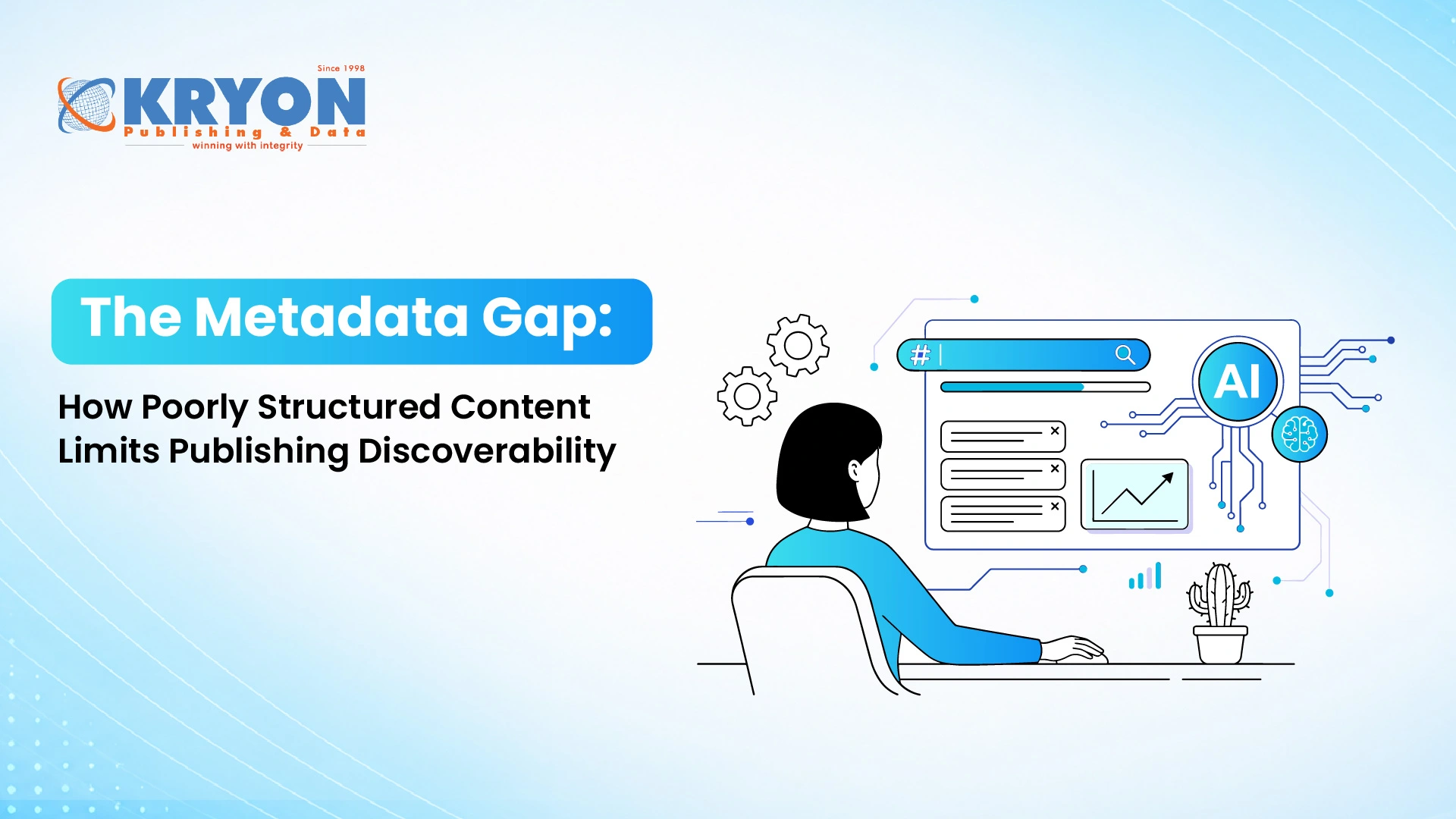
Publishers have spent decades perfecting the words on the page editing, proofreading, and refining content until it reads well. But increasingly, how content reads is only half the equation. How content is structured has become just as important yet structural and metadata gaps remain a challenge across many publishing workflows.
This is the metadata gap: the growing distance between content that's well-written and content that's genuinely findable, linkable, and usable across the platforms readers, researchers, and AI systems now rely on. For publishers who haven't closed that gap, the impact can appear as indexing issues, broken citation links, reduced discoverability, and content that becomes harder for readers and systems to find, regardless of how strong the writing is underneath.
Structured content isn't about formatting for appearance bold headings, clean columns, a nice PDF layout. It's about whether the underlying content carries machine-readable meaning: whether a database, search engine, or AI system can tell what a heading is, what a citation refers to, what an author's name is versus a journal title, or what a figure actually depicts.
Most legacy publishing content wasn't built this way. It was built to look right on a printed page or a static PDF, with structure implied visually rather than encoded explicitly. A human reader can tell a subheading from a caption at a glance. A machine, without proper markup, often can't.
That gap between what a human understands intuitively and what a machine can actually parse is where discoverability quietly breaks down.
Discovery and indexing depend heavily on structure. Discovery platforms, indexing services, and scholarly infrastructure depend on accurate, structured metadata. Incomplete or inconsistent metadata can reduce the reliability of content identification, linking, retrieval, and discovery across publishing ecosystems even when the underlying content itself is high quality.
Metadata accuracy affects linking and retrieval. A misattributed author, an inconsistent journal title format, or an incomplete DOI record doesn't just create an inconvenience it can break the links that allow readers, systems, and other publications to reliably find and connect to the work.
AI-driven discovery raises the bar further. As more content discovery moves through AI-powered search and answer tools, structured and semantically clear content can make it easier for machines to interpret relationships between authors, references, sections, entities, and other publication elements. This doesn't guarantee visibility or citation, but it removes a real barrier that poorly structured content creates by default.
Multi-format delivery depends on structure. Publishers today need to deliver content across print, PDF, EPUB, HTML, and XML. Without a structured source underlying these outputs, publishers may need to manage formats through separate production processes, increasing production effort and the risk of inconsistencies between versions.
The metadata gap rarely comes from one obvious failure. It usually accumulates in smaller places:
Inconsistent or incomplete DOI and metadata records, which affect how reliably content can be identified and linked
Non-standardized author and affiliation data, which affects attribution and retrieval accuracy
Missing accessibility information, including meaningful alt text for visual content, which can reduce accessibility and limit the semantic completeness of a digital publication
Legacy content converted from PDF-first workflows, where structure was never explicitly encoded, only visually implied
Content maintained across disconnected systems, where metadata standards drift between departments, journals, or platforms over time
Individually, each of these looks like a minor gap. Together, across a large content library, they compound into a discoverability problem that's difficult to trace back to any single cause which is exactly why it tends to go unaddressed for years.
The publishers managing this well share a common approach: they treat structure as infrastructure, not as a final formatting step applied after content is finished.
That typically means adopting structured, XML-based publishing workflows, where content whether it originates in Word, PDF, legacy formats, or other source files is transformed into semantically tagged content that can support multiple publication outputs from a single source. It means treating metadata (author data, identifiers, citations, taxonomies, accessibility information) as a first-class part of content production, validated at every stage rather than checked once before publication and left alone afterward.
It also means auditing legacy content, not just new content. A publisher's back catalog often represents years, sometimes decades, of material that was never structured for today's discovery systems, and closing the metadata gap usually means addressing that backlog deliberately, rather than only fixing the problem going forward.
Publishers can reduce metadata gaps by validating structured content throughout production, standardizing metadata across platforms, and reviewing legacy content created before modern digital publishing requirements existed.
The gap between well-written content and well-structured content is no longer a minor technical detail it's a meaningful factor in whether that content is reliably found, linked, and used at all. As discovery increasingly runs through databases, indexing systems, and AI-driven search alongside traditional readership, structure has become a foundational part of a publication's reach.
Kryon Publishing helps organizations strengthen digital content through structured XML conversion, metadata enrichment, content transformation, and multi-format publishing helping make publication content more structured, accessible, reusable, and discoverable across digital platforms
Ready to close your metadata gap? Explore Data Solutions
It's the difference between content that's well-written and content that's properly structured and tagged for discovery a gap that can affect how reliably content is identified, linked, indexed, and found across publishing platforms and AI-driven search tools.
Discovery platforms and indexing systems rely on accurate, structured metadata to identify, link, and retrieve content reliably. Poorly structured content, even when well-written, is more likely to face indexing or linking issues.
Inconsistent author and affiliation data, incomplete identifier or DOI records, missing accessibility information such as alt text, and legacy PDF-first content that was never structured for modern indexing systems.
When content is built from a single structured source, it can be reliably transformed into print, PDF, EPUB, HTML, and XML outputs without rebuilding each format separately or risking inconsistency between versions.
By auditing both new and legacy content for structural and metadata gaps, adopting structured, XML-based publishing workflows, and standardizing metadata practices across platforms and teams.




Copyright @ 2025, Kryon Publishing Services. All Rights Reserved

