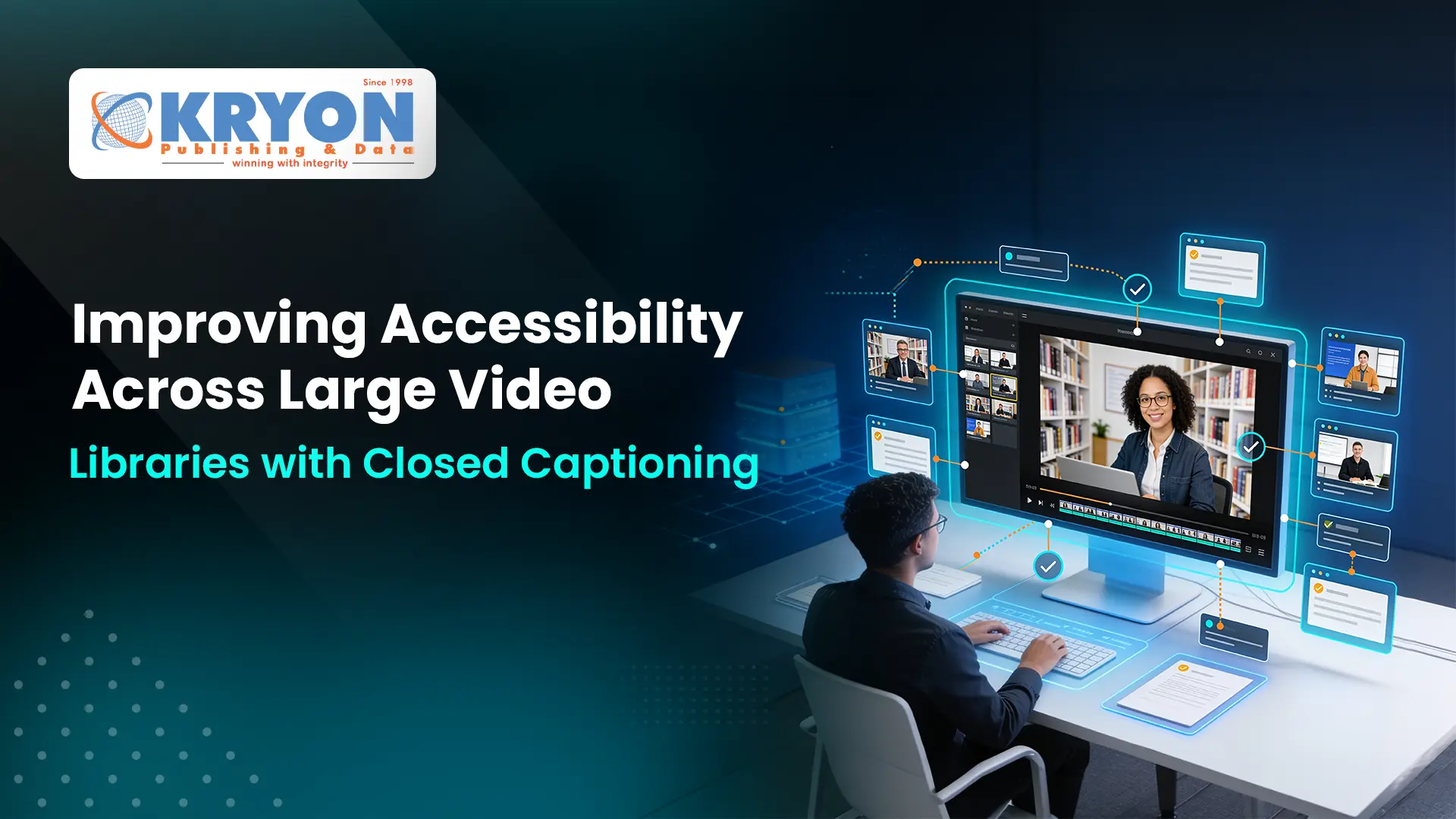
Organizations increasingly maintain extensive libraries of video content, including educational materials, training programs, lectures, webinars, interviews, presentations, and digital media archives.
As these collections grow, ensuring accessibility and maintaining consistent caption quality across hundreds or thousands of videos can become challenging. Videos without accurate captions can create barriers for viewers who are deaf or hard of hearing and can also limit usability in environments where audio cannot be played or clearly understood.
Kryon Publishing Services will support organizations with structured closed captioning, transcription, synchronization, quality validation, and multilingual workflows designed around their content and accessibility requirements.
Managing accessibility across a large video library can involve several challenges:
Videos may have missing or incomplete captions.
Automatically generated captions may contain transcription errors.
Technical terminology, names, acronyms, and subject-specific language may be captured incorrectly.
Captions may not be properly synchronized with the audio.
Multiple speakers may not be clearly identified.
Relevant non-speech audio may be omitted.
Caption formatting may be inconsistent across the video library.
Multilingual content may require captioning, subtitling, or localization.
Large content volumes can make fully manual captioning difficult to scale.
Simply converting speech into text will not be enough. Effective closed captions need to be accurate, synchronized, readable, appropriately formatted, and quality-checked to support an accessible viewing experience.
1. Video Library Assessment
The workflow will begin with an assessment of the video collection, including content type, duration, language, audio quality, subject complexity, existing captions, and required output formats.
Videos can then be categorized according to their captioning requirements and complexity, helping establish an appropriate production and validation workflow.
2. Technology-Assisted Transcription
Spoken content will be converted into text using technology-assisted transcription. The resulting transcripts will undergo appropriate review to address potential errors involving names, technical terminology, acronyms, punctuation, and contextual meaning.
This approach will combine automation with quality review to support efficient processing across large video collections.
3. Caption Synchronization
Captions will be synchronized with spoken dialogue to help viewers follow the relationship between the audio, visuals, and displayed text.
Timing, segmentation, and line breaks will be managed to maintain readability and a natural viewing experience.
4. Speaker Identification and Audio Cues
Where appropriate, speakers will be identified in interviews, panel discussions, lectures, and other multi-speaker content.
Relevant non-speech information, such as meaningful sound effects and music cues, can also be represented when necessary to preserve important context.
5. Caption Formatting and Readability
Consistent practices for punctuation, segmentation, line breaks, timing, and caption presentation will be applied according to the content and target platform.
This will help provide a more consistent viewing experience across large video libraries.
6. Multilingual Captioning and Subtitling
For organizations serving multilingual or international audiences, Kryon Publishing will support captioning, subtitling, and multimedia localization based on the required languages, content types, and distribution platforms.
7. Quality Validation
Completed captions will be reviewed for key quality factors, including:
Transcription accuracy
Timing and synchronization
Speaker identification
Terminology and names
Punctuation and readability
Relevant non-speech information
Formatting consistency
Required file structure
The appropriate combination of automated and manual review will depend on the complexity of the content and project requirements.
8. Delivery for Digital Platforms
Final caption files will be prepared in formats appropriate for the organization's websites, video platforms, learning environments, and other digital channels, based on the technical requirements of each destination.
A structured closed-captioning workflow can help organizations:
Improve accessibility for viewers who are deaf or hard of hearing.
Improve usability when audio is unavailable or difficult to hear.
Maintain greater caption consistency across large video collections.
Improve the quality of existing auto-generated captions.
Reduce dependence on fully manual caption production.
Support multilingual and international audiences.
Scale captioning workflows as video libraries continue to grow.
Actual results will depend on factors such as audio quality, language, terminology, content complexity, accessibility requirements, and target platforms.
Making large video libraries more accessible will require more than simply generating text from audio. Caption accuracy, synchronization, readability, speaker identification, relevant audio cues, consistent formatting, and quality validation will all contribute to a better viewing experience.
By combining technology-assisted transcription with structured captioning, synchronization, multilingual support, and appropriate quality review, Kryon Publishing will help organizations make video collections more accessible, consistent, and usable across digital platforms.
Looking to improve accessibility across your video library?
Connect with Kryon Publishing to explore a closed-captioning workflow tailored to your content, languages, platforms, and accessibility requirements.
Closed captioning represents spoken dialogue and relevant audio information as synchronized text, helping make video content more accessible.
Accurate captions improve accessibility, comprehension, consistency, and usability across large collections of video content.
Yes. Auto-generated captions can be reviewed and corrected for transcription errors, terminology, names, timing, punctuation, speaker identification, and formatting.
Closed captions typically represent dialogue along with relevant non-speech audio information, while subtitles primarily represent or translate spoken dialogue.
Yes. Existing collections can be assessed and processed based on their content type, language, audio quality, complexity, and required output formats.
Yes. Multilingual requirements can be addressed through captioning, subtitling, and localization workflows based on the required languages and target audience.



Copyright @ 2025, Kryon Publishing Services. All Rights Reserved

