
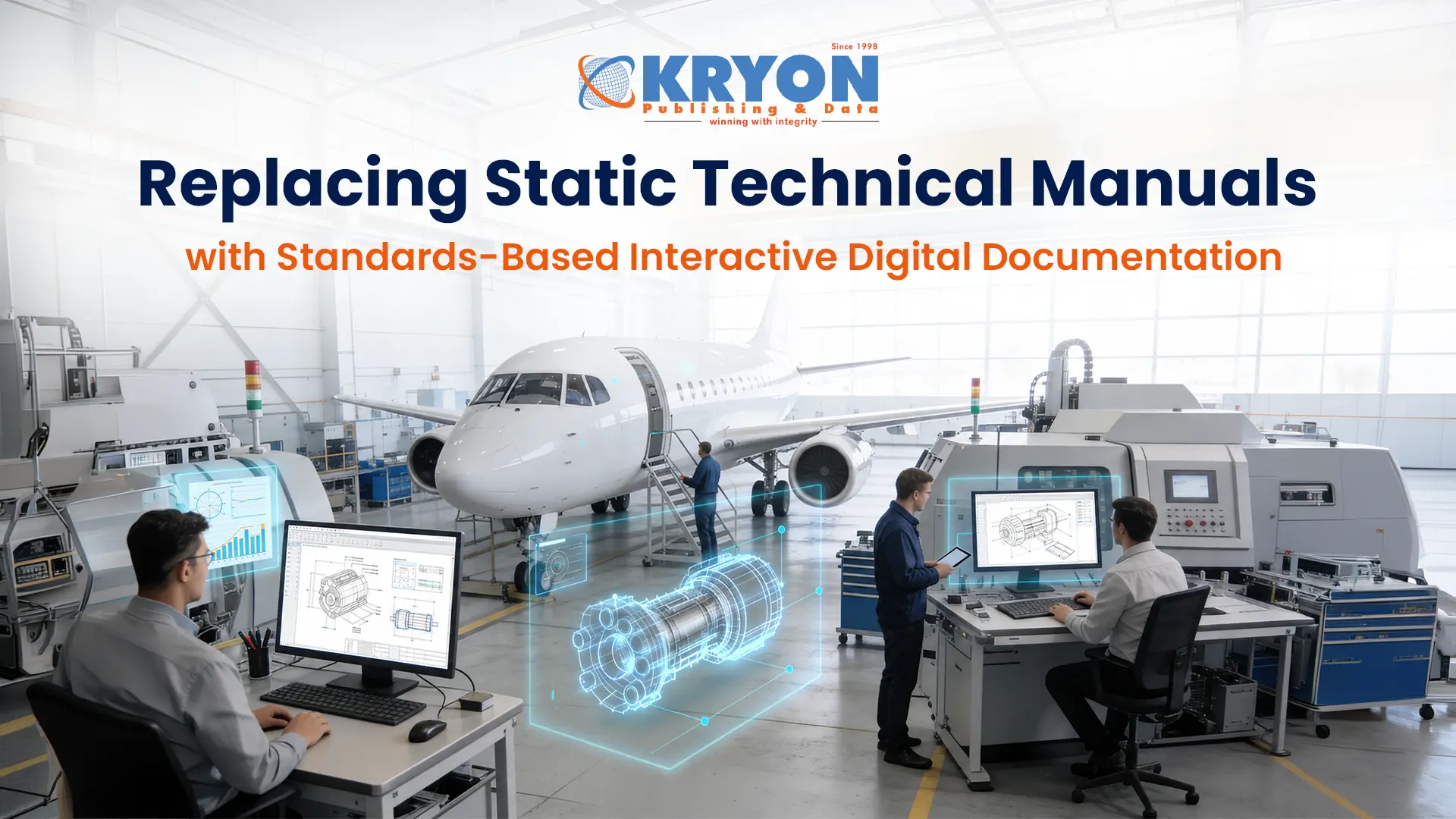
Organizations across Aerospace, Defense, Automotive, Manufacturing, Railways, Marine, and Heavy Engineering rely on technical documentation for equipment installation, operation, maintenance, inspection, repair, and troubleshooting.
As equipment becomes more sophisticated and documentation requirements become increasingly complex, static PDFs and page-based manuals can make technical information difficult to search, update, control, and reuse.
Kryon Publishing helps organizations transform traditional technical manuals into structured, standards-based digital technical documentation and Interactive Electronic Technical Manuals (IETMs).
Depending on the industry, project, and documentation requirements, technical content can be structured and delivered in alignment with relevant industry standards and specifications, including S1000D, ATA iSpec 2200, ASD-STE100, S2000M, S3000L, and other applicable technical documentation standards.
Traditional document-based technical publishing creates challenges when organizations manage large volumes of complex technical information.
Common challenges include:
Technicians spending significant time searching through lengthy manuals to locate specific procedures or specifications.
Difficulty maintaining consistency across multiple document versions and revisions.
Manual and time-consuming processes for updating technical content.
Limited accessibility of critical information in field and operational environments.
Difficulty connecting procedures with diagrams, schematics, illustrations, and related information.
Recreating similar content across multiple manuals instead of reusing structured information.
Challenges in maintaining documentation according to industry-specific standards and specifications.
Difficulty producing the same technical content across multiple required formats and platforms.
Organizations therefore need a structured, standards-aware approach to technical information management and digital publishing.
Kryon Publishing helps organizations convert existing technical documentation into structured, searchable, interactive, and standards-aligned digital technical content.
Standards-Based Content Structuring
Technical content can be structured according to the requirements of the applicable industry or customer specification.
Depending on the project, this may include standards such as:
S1000D – International specification for technical publications
ATA iSpec 2200 – Aviation industry technical information
ASD-STE100 – Simplified Technical English
S2000M – Material management and logistics support
S3000L – Logistics support analysis
Other customer-specific, industry-specific, XML, or technical publication specifications
This approach helps establish a structured content foundation rather than maintaining technical information only as static pages.
Structured XML Content
Existing technical manuals can be converted into structured XML-based content, allowing information to be organized into reusable and manageable content components.
This supports better content reuse, revision management, search, cross-referencing, and controlled publishing.
Interactive Navigation and Search
Structured technical content can be presented through interactive digital documentation with:
Intelligent search
Structured navigation
Clickable cross-references
Linked procedures
Equipment and component references
Context-based information access
Technicians can locate relevant information faster without manually navigating through lengthy PDF documents.
Technical Illustrations and Cross-References
Diagrams, schematics, technical illustrations, and figures can be integrated with the relevant technical procedures.
Where required, interactive callouts and linked references can connect components within an illustration to their corresponding technical information.
Content Reuse and Revision Management
A structured content approach allows technical information to be reused across different manuals, equipment configurations, and publishing outputs.
Controlled content updates can also help organizations maintain approved technical information and reduce inconsistencies between different versions.
Multi-Format and Digital Delivery
Structured technical content can be prepared for delivery across approved platforms, devices, and digital formats based on operational and customer requirements.
This enables organizations to maintain a common content foundation while supporting different publishing and delivery requirements.
Aerospace & Aviation
Aircraft maintenance manuals, component documentation, inspection procedures, repair instructions, troubleshooting information, and technical publications.
Defense
Military equipment documentation, maintenance manuals, repair procedures, system documentation, and operational technical information.
Automotive
Vehicle service information, repair manuals, maintenance procedures, component documentation, and diagnostic information.
Manufacturing
Machinery manuals, installation instructions, operating procedures, maintenance documentation, and troubleshooting guides.
Railways
Rolling stock documentation, maintenance procedures, inspection instructions, repair information, and railway system documentation.
Marine & Heavy Engineering
Equipment operation, maintenance, servicing, installation, inspection, and troubleshooting documentation for complex engineering systems.
Moving from static manuals to structured digital technical documentation can help organizations:
Accelerate technical information retrieval.
Improve usability for technicians and field teams.
Strengthen revision and version control.
Reduce duplicated technical content.
Improve consistency across documentation.
Support applicable industry and customer standards.
Enable content reuse across multiple publications.
Support multiple digital publishing requirements.
Establish a scalable technical content management foundation.
Modern technical documentation requires more than converting printed manuals into PDFs or digital pages. Organizations managing complex products and systems need structured, reusable, searchable, controlled, and standards-aligned technical information.
Kryon Publishing helps organizations transform legacy technical manuals into interactive digital technical documentation and IETMs, supported by structured XML content, technical illustrations, cross-referencing, content reuse, revision management, and applicable industry standards.
Whether the requirement involves S1000D, ATA iSpec 2200, ASD-STE100, S2000M, S3000L, or other customer-specific technical publication requirements, Kryon Publishing provides a flexible foundation for modern technical information delivery.
Ready to modernize your technical documentation? Explore Technical Documentation & IETM Solutions →Depending on project requirements, technical documentation can be developed or structured around standards and specifications such as S1000D, ATA iSpec 2200, ASD-STE100, S2000M, S3000L, and other applicable customer or industry requirements.
Yes. Existing manuals can be analyzed and transformed into structured XML-based content, depending on the quality and structure of the source material.
No. S1000D is a specification for structuring and managing technical information, while an IETM is an interactive digital environment for accessing technical information. S1000D and other standards can provide the structured content foundation for digital technical documentation.
Aerospace, defense, automotive, manufacturing, railways, marine, heavy engineering, and other industries managing complex technical systems can benefit from structured digital documentation.
Yes. Structured content enables reusable technical information to be maintained and incorporated into multiple publications or documentation outputs where appropriate.



Copyright @ 2025, Kryon Publishing Services. All Rights Reserved

