
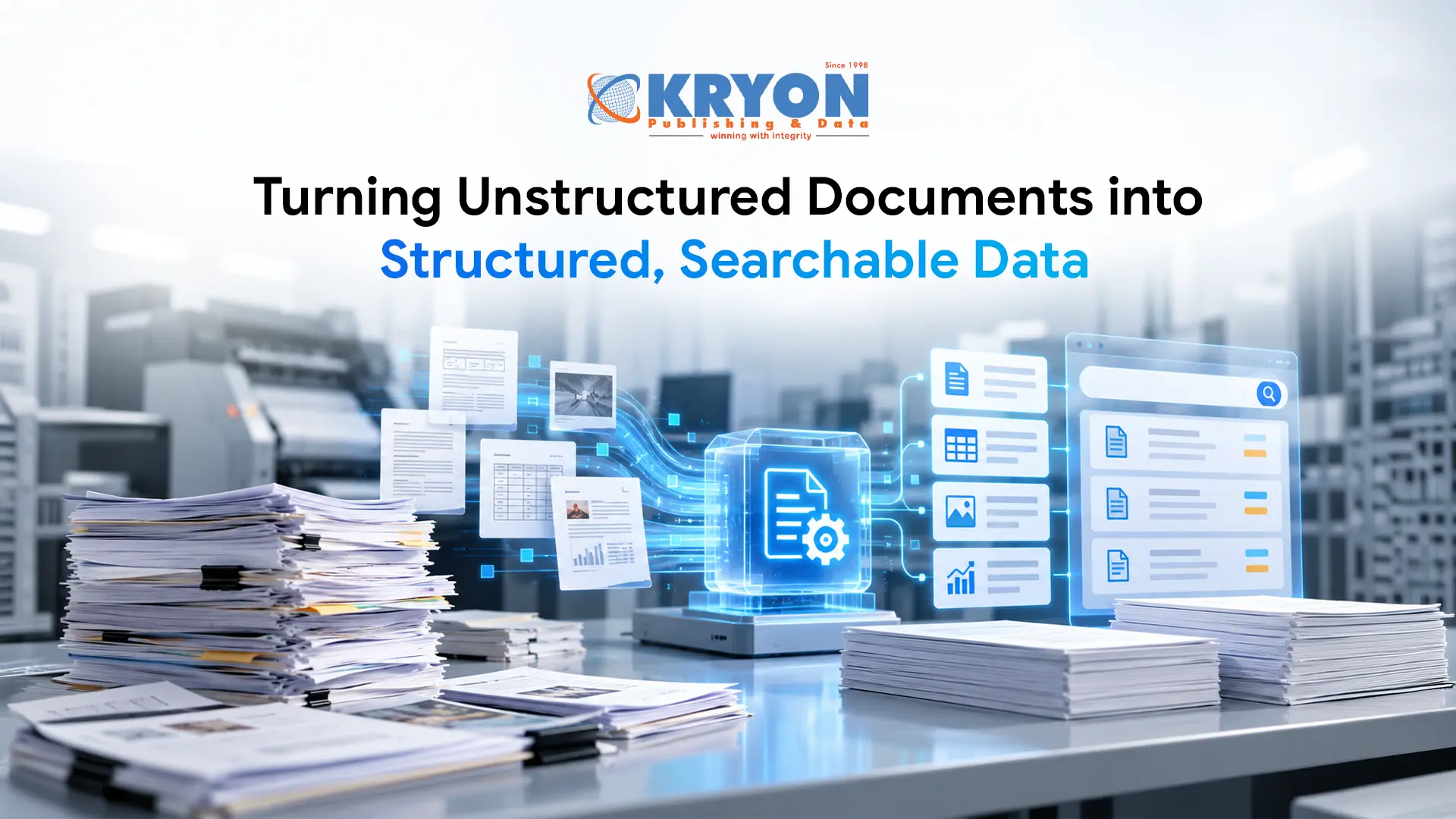
Organizations often hold valuable information within scanned documents, PDFs, reports, forms, research materials, and legacy archives. When this content is unstructured or image-based, finding, extracting, and reusing information can require significant manual effort.
Kryon Publishing will help organizations transform these document collections into structured, searchable, and usable information through OCR, automated data extraction, content categorization, metadata structuring, and quality validation.
Large collections of unstructured documents can create several challenges:
Scanned or image-based text may not be searchable.
Important information may be spread across thousands of pages and files.
Manual data entry can be time-consuming and inconsistent.
Documents may lack standardized metadata and classification.
Different document types may require different extraction rules.
Growing document volumes can make manual processing difficult to scale.
The challenge is not simply to digitize documents, but to make the information within them searchable, structured, and reusable.
1. Document Assessment
Documents will be assessed based on their format, quality, structure, volume, and data requirements to determine the appropriate processing workflow.
2. OCR and Text Recognition
Optical Character Recognition (OCR) will convert text from scanned pages and image-based documents into machine-readable content, making it available for searching, indexing, and further processing.
3. Automated Data Extraction
Automated and AI-assisted processes will help extract relevant information such as:
Titles | Authors | Dates | Identifiers | Keywords | Categories | Tables | Defined Data Fields
The exact information extracted will depend on the document type and project requirements.
4. Content Categorization
Documents can be categorized using predefined criteria such as document type, subject, department, date, or content category, creating a more organized information resource.
5. Metadata Structuring
Relevant metadata will be created, standardized, and validated to improve document identification, organization, search, and retrieval.
6. Quality Validation
OCR text, extracted fields, metadata, and classifications will undergo appropriate automated checks and manual review to identify missing, inconsistent, or incorrectly interpreted information.
7. Structured Data Delivery
Processed information can be prepared in structured formats suitable for repositories, databases, content management systems, analytics environments, and other downstream applications, based on project requirements.
A structured document-processing workflow can help organizations:
Make previously unsearchable content easier to discover.
Reduce repetitive manual data processing.
Improve metadata and document classification consistency.
Make legacy information easier to access and manage.
Support integration with repositories and digital systems.
Prepare structured information for analytics and other data-driven workflows.
Scale document processing across larger collections.
Digitization creates digital files. Structured data extraction makes the information within those files more usable.
By combining OCR, automated data extraction, content categorization, metadata structuring, and quality validation, Kryon Publishing will help organizations transform complex document collections into organized, searchable, and reusable information resources.
Looking to unlock information from unstructured documents?
Connect with Kryon Publishing to explore a document transformation workflow tailored to your content and data requirements.
It is information contained in documents such as scanned files, PDFs, reports, forms, and archives that is not organized into predefined structured fields.
OCR converts text in scanned or image-based documents into machine-readable content that can be searched, indexed, and processed.
Depending on the project, information such as titles, authors, dates, identifiers, keywords, tables, categories, and defined data fields can be extracted.
Structured metadata improves document organization, identification, searchability, and retrieval.
Yes. Outputs can be prepared for repositories, databases, content management systems, analytics environments, and other downstream applications based on system requirements.




Copyright @ 2025, Kryon Publishing Services. All Rights Reserved

