
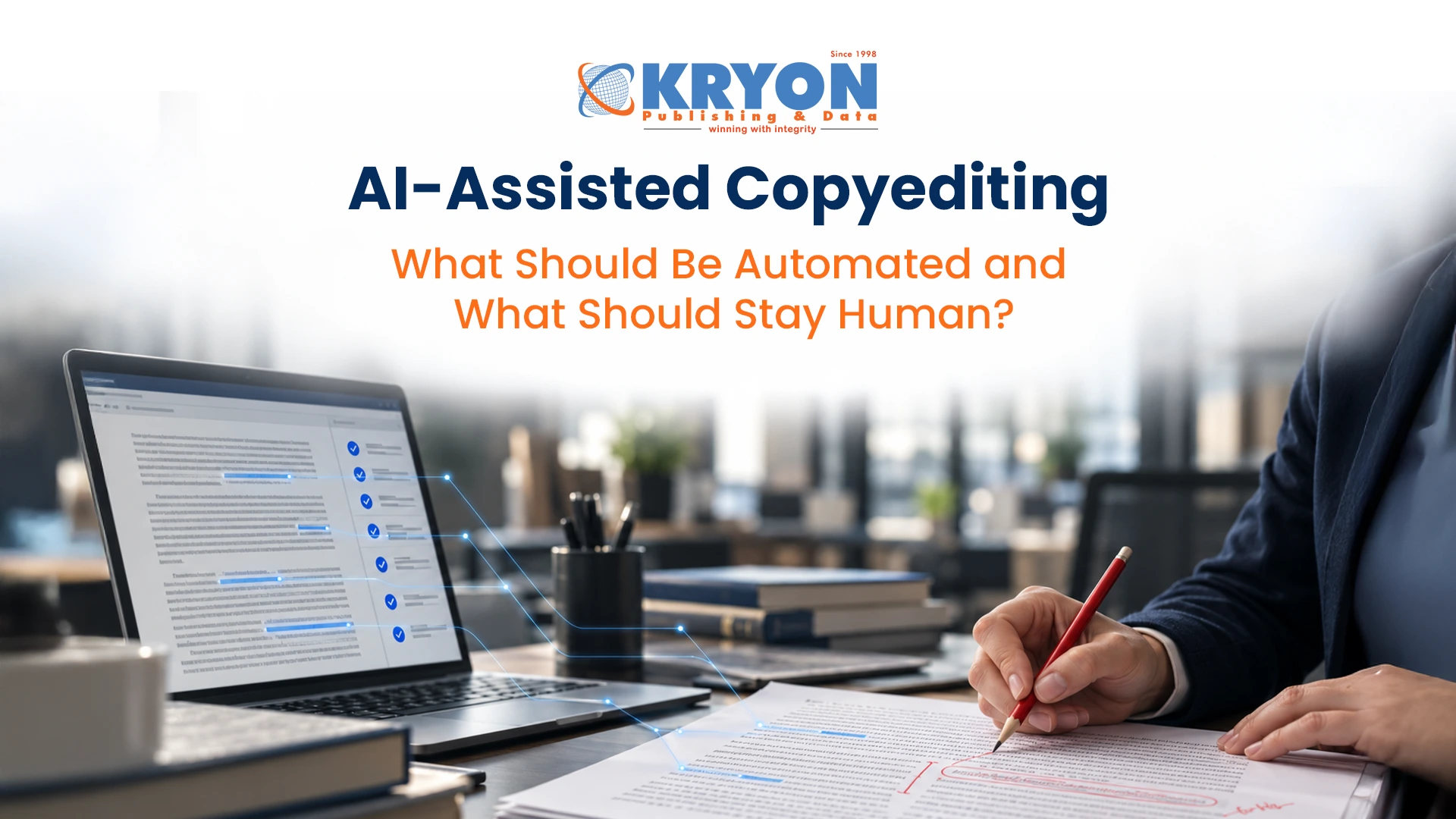
Artificial intelligence is becoming increasingly integrated into publishing workflows, including one of the most detail-oriented stages of content production: copyediting.
AI-assisted technologies can support grammar checking, spelling correction, style suggestions, consistency review, and other repetitive editorial tasks. For publishers managing growing content volumes and demanding production schedules, these capabilities can provide practical support to editorial teams.
However, copyediting is not simply about correcting errors. It also requires context, meaning, subject awareness, editorial judgment, author intent, and publication standards.
This creates an important question: What should be automated, and what should remain under human editorial control?
AI is particularly useful for repetitive, rule-based, and pattern-driven editorial tasks. Used appropriately, it can help identify potential issues while allowing editors to focus on areas requiring professional judgment.
AI-assisted tools can help identify spelling, grammar, punctuation, and sentence-structure issues. They can also suggest improvements to wording, style, and readability.
However, automated suggestions should not automatically be accepted. A grammatically correct change may still alter technical meaning, authorial voice, or discipline-specific terminology. Human validation therefore remains important.
Maintaining consistency throughout a manuscript can require considerable editorial attention.
AI and rule-based tools can assist in identifying potential variations in areas such as spelling, capitalization, abbreviations, terminology, numbering, headings, and formatting patterns.
Automation can help locate inconsistencies efficiently, while editors determine whether changes are appropriate within the context of the publication.
Publishers and journals often follow specific editorial standards, client requirements, or house styles.
AI-assisted and rule-based tools can support editors by identifying content that may not align with defined conventions. Editors can then evaluate flagged content against the required style and determine whether a correction or exception is appropriate.
Technology can therefore support the checking process without replacing editorial responsibility.
Some copyediting activities involve systematic checks across large amounts of content.
Automation can help identify repeated words, inconsistent terminology, formatting variations, and other detectable patterns. This can reduce manual searching and allow editors to focus more attention on issues requiring contextual review.
The more a copyediting task depends on meaning, nuance, subject knowledge, or interpretation, the more important human involvement becomes.
A sentence can be grammatically improved while becoming scientifically, technically, or contextually inaccurate.
Human copyeditors need to determine whether a proposed change preserves what the author intended to communicate. This is particularly important in academic, scientific, medical, legal, and technical publishing, where minor wording changes can affect interpretation.
AI can identify text that appears unclear, but resolving ambiguity may require understanding the manuscript as a whole.
An editor may need to determine whether an issue involves grammar, structure, terminology, missing information, or underlying meaning. In some cases, clarification from the author may be more appropriate than an automated rewrite.
Specialized publications frequently contain terminology, abbreviations, nomenclature, equations, and writing conventions that differ from general-language usage.
Automated tools may sometimes flag technically correct terminology because it is uncommon. Human review helps ensure that language improvements do not unintentionally change technical or subject-specific meaning.
Copyediting involves more than modifying sentences.
Editors must recognize when information is unclear, contradictory, incomplete, or significant enough to require clarification. Deciding when to raise an author query and determining the appropriate level of editorial intervention require professional judgment.
Automated systems should not independently make consequential editorial decisions involving sensitive language, authorship, research claims, attribution, conflicts, or matters requiring interpretation of editorial policies.
Human oversight remains important where editorial changes could affect meaning, integrity, attribution, or publication responsibility.
The future of copyediting does not need to be framed as AI versus human editors.
A practical model is to use AI as an editorial assistance layer.
Automation can perform initial checks, identify patterns, flag potential inconsistencies, and suggest corrections. Professional copyeditors can then review those suggestions, evaluate context, preserve author meaning, resolve ambiguity, and approve appropriate changes.
The principle is straightforward:
Automate detection. Support correction. Keep judgment human.
This approach allows publishers to gain practical value from automation without assuming that every AI-generated suggestion is accurate or appropriate.
Publishers introducing AI into editorial workflows should establish clear boundaries around its use.
This includes determining which activities can be supported through automation, which changes require editorial approval, how unpublished or sensitive manuscripts are handled, and whether publisher, author, or client requirements restrict AI use.
Editorial changes should remain reviewable and traceable where required. AI assistance should also not remove appropriate quality control before content progresses to typesetting, production, or publication.
AI-assisted copyediting can provide practical support for language checks, consistency review, style suggestions, and repetitive editorial tasks. Its value is greatest when technology helps editors identify potential issues rather than treating automated suggestions as inherently correct.
Human copyeditors remain essential for protecting meaning, interpreting context, handling specialized terminology, resolving ambiguity, communicating with authors, and making decisions requiring professional judgment.
The effective approach is to combine automation for efficiency with human expertise for context, accuracy, and editorial control.
At Kryon Publishing, AI-assisted technologies support modern publishing processes, while professional editorial services provide manuscript editing, proofreading, copyediting, and accuracy checking. Kryon Publishing Together, technology and editorial expertise can support efficient, quality-focused content production.
AI-assisted copyediting uses AI and automated tools to support tasks such as grammar checking, spelling correction, style suggestions, consistency checks, and identification of potential language issues.
AI can support repetitive and pattern-based tasks, but human editors remain important for understanding context, preserving author meaning, handling ambiguity, and making editorial judgments.
Automation can assist with grammar, spelling, punctuation, style patterns, terminology consistency, formatting variations, and other rule-based checks. Human review should determine whether suggested changes are appropriate.
Human editors can evaluate subject-specific terminology, context, author intent, ambiguous statements, and sensitive editorial issues that automated systems may not interpret correctly.
A balanced approach combines automation for repetitive checks with human validation for context, accuracy, and editorial judgment, allowing technology to support rather than replace professional copyediting.




Copyright @ 2025, Kryon Publishing Services. All Rights Reserved

