
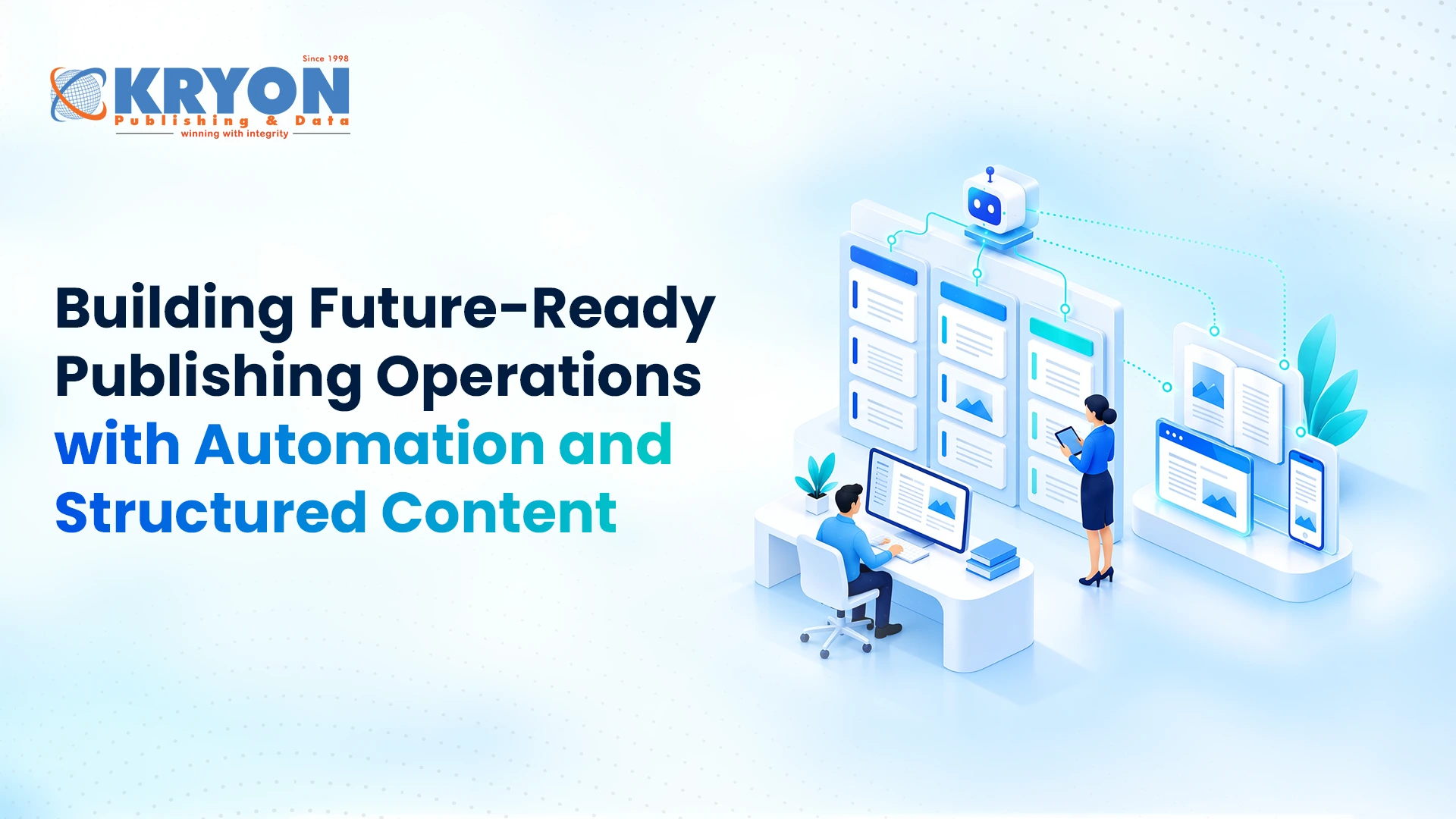
Publishing operations are becoming increasingly complex as organizations manage growing content volumes, multiple digital formats, accessibility requirements, shorter production timelines, and evolving distribution channels.
Traditional publishing workflows may involve several manual and disconnected activities across content preparation, editorial processing, formatting, conversion, quality control, and delivery. When content moves between different teams, tools, and formats, the same information may need to be reviewed, reformatted, transformed, or validated multiple times.
This can create challenges such as repetitive manual work, inconsistent content structures, multiple versions, production delays, limited workflow visibility, and additional quality-control effort.
Another challenge is the way content itself is created and maintained. When information is closely tied to a particular document or presentation format, adapting it for PDF, HTML, EPUB, accessible digital publications, repositories, or future delivery channels may require additional transformation and production work.
At the same time, AI and automation are creating opportunities to support selected publishing activities. However, introducing these technologies without structured workflows, appropriate controls, and professional oversight can create additional concerns around quality, consistency, confidentiality, and editorial accuracy.
Publishers therefore need an approach that brings together structured content, appropriate automation, AI-assisted processes, and professional publishing expertise rather than treating each technology as an independent solution.
Kryon Publishing can support organizations in developing publishing operations that combine structured content workflows, automation, AI-assisted capabilities, and professional quality control according to specific content and production requirements.
1. Establishing Structured Content Foundations
Future-ready publishing begins with content that can be managed independently from a single final presentation format.
Structured approaches using technologies such as XML, HTML, and LaTeX can help organize and represent content systematically. Depending on the publication type, this may include titles, headings, paragraphs, references, figures, tables, metadata, and other content elements.
A structured foundation can make content easier to transform, maintain, reuse, and prepare for different publishing requirements.
2. Supporting Multi-Format Content Production
A structured content foundation can support the preparation of PDF, HTML, EPUB, accessible digital formats, repositories, and other publishing outputs while reducing unnecessary duplication between production processes.
Each format still has its own technical, presentation, accessibility, and delivery requirements. Appropriate transformation, validation, and quality assurance therefore remain necessary for individual outputs.
The objective is not to assume that one source automatically creates every final format, but to establish a reusable content foundation that can support different publishing channels.
3. Automating Repeatable Publishing Activities
Automation can be introduced where publishing activities are predictable and rule-based.
Depending on workflow requirements, automated processes can support activities such as structural validation, predefined content checks, metadata processing, file preparation, conversion activities, and selected quality-control checks.
Automation should be applied where it provides practical value rather than attempting to automate every publishing decision. Editorial and production specialists can remain responsible for exceptions and tasks requiring contextual or professional judgment.
4. Introducing AI-Assisted Publishing Responsibly
AI-assisted technologies can support selected editorial and production activities, including language checks, content refinement, metadata processing, categorization, and other pattern-based tasks where appropriate.
AI-generated suggestions should remain subject to suitable review, particularly when changes may affect author meaning, technical terminology, research content, accessibility, or publication quality.
Clear controls around confidential or unpublished content, data handling, approvals, and human oversight are also important when AI is incorporated into publishing processes.
5. Integrating Quality Throughout the Workflow
Quality control does not need to be concentrated only at the final production stage.
Automated and rule-based validation can help identify detectable structural or technical issues during appropriate stages of content processing. Professional editors and production specialists can then review areas requiring contextual, visual, editorial, or accessibility judgment.
This combination can help identify suitable issues earlier while maintaining professional quality assurance where automation alone is insufficient.
6. Preparing Content for Future Requirements
Publishing formats, platforms, standards, and technologies will continue to evolve.
Maintaining well-structured source content can provide greater flexibility when organizations need to migrate content, introduce additional delivery formats, update accessibility processes, integrate publishing systems, or support emerging digital environments.
Future readiness therefore depends not only on adopting new technologies but also on building content and workflows that can adapt as publishing requirements change.
Building future-ready publishing operations is not simply about introducing AI or automating existing manual processes.
A more sustainable approach combines structured content, targeted automation, responsible AI assistance, multi-format production, and professional quality control within a coordinated publishing workflow.
Human expertise will remain essential for editorial judgment, complex content, accessibility review, quality assurance, and decisions that cannot be reliably handled through predefined rules or automated suggestions.
At Kryon Publishing, expertise in structured publishing, XML-based workflows, digital content transformation, multi-format production, accessibility, AI-assisted publishing, and quality-focused processes can support organizations as they modernize their publishing operations.
The objective is to create publishing workflows that are more adaptable, reusable, consistent, and prepared for evolving content and technology requirements, while keeping professional oversight at the center of publication quality.
Future-ready publishing operations use adaptable content structures, appropriate automation, digital workflows, and professional quality control to support evolving formats, platforms, and publishing requirements.
AI-assisted technologies can support selected tasks such as language checks, content refinement, metadata processing, categorization, and other pattern-based activities, with appropriate human review.
Structured content can make information easier to maintain, transform, reuse, and prepare for different outputs such as PDF, HTML, EPUB, and accessible digital formats.
No. Automation can support repetitive and rule-based activities, while publishing professionals remain important for editorial judgment, complex content, accessibility review, and quality assurance.
Structured content provides a reusable content foundation, automation supports repeatable processes, and AI can assist selected editorial and production activities. Professional oversight helps ensure that these technologies are applied appropriately.




Copyright @ 2025, Kryon Publishing Services. All Rights Reserved

